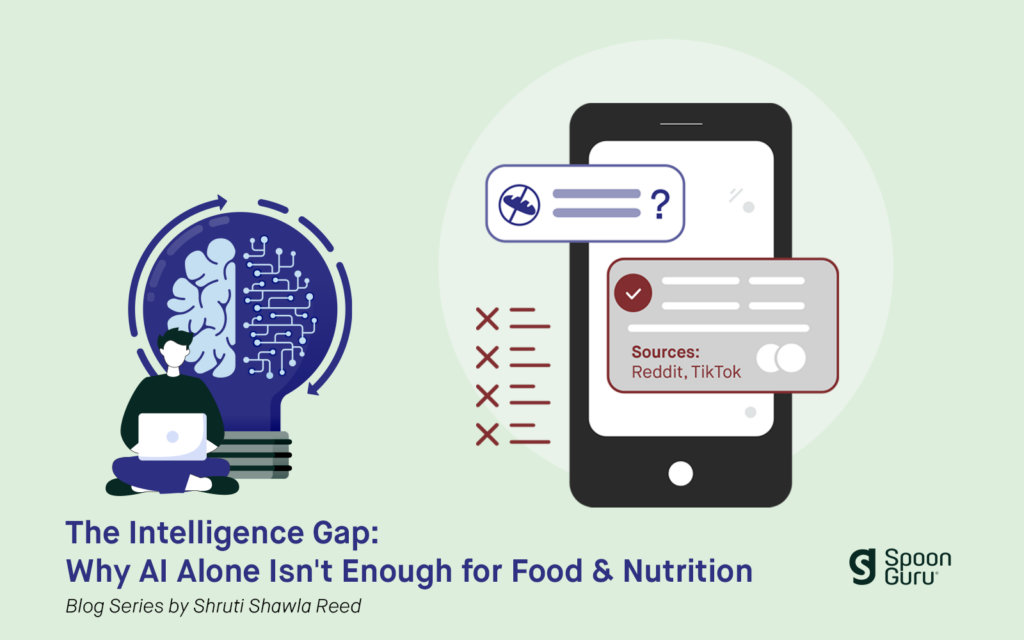
There is a quiet health crisis unfolding in plain sight. Millions of people managing complex, chronic, or condition-specific dietary needs such as GLP-1 prescriptions, cardiovascular risk, Type 1 and Type 2 diabetes, perimenopause, IBS, kidney disease are turning to ChatGPT, Google, and TikTok for food guidance instead of qualified professionals. Not because they are reckless, but because access to personalised dietary support is expensive, slow, and patchy. A KFF survey from August 2024 found that about one in six adults now use AI chatbots at least once a month to find health information and advice, rising to one in four among those under 30. For businesses operating in food, retail, or health technology, this is not a distant consumer trend. It is happening in your digital aisle, right now.
The scale of the population navigating condition-specific dietary needs is larger than most product and technology teams appreciate. More than five million people in the UK are living with diabetes, an all-time high with the total cost to the NHS estimated at £10.7 billion, and projected to reach £18 billion by 2035 if prevalence continues to rise. There are currently around 13 million perimenopausal or menopausal women in the UK, equating to around one-third of the entire female population. Approximately 7.6 million people in the UK live with cardiovascular disease, with high blood pressure diagnosed in 14.4 million adults and many more likely undiagnosed. These are not niche demographics. They are mainstream retail customers, pharmacy visitors, and digital health app users and almost all of them have dietary requirements that generic AI simply cannot handle safely.
The challenge is not just that these individuals are using AI tools that lack clinical accuracy. It is that generic AI treats complex conditions as monoliths. It does not distinguish between Type 1 and Type 2 diabetes, or recognise that a “low carb” preference may directly conflict with a “high fibre” medical necessity. It does not understand that a woman in perimenopause managing cardiovascular risk and a soy intolerance simultaneously needs intersectional dietary logic not a single-tag filter. The BDA investigation found exactly this pattern: AI models gave a mix of general messages with bits of scientific language, piecing together information without critically considering it, leading to confusing or even potentially dangerous outputs. When the platform fails to serve these customers well, they do not disappear; they go elsewhere, or they go unserved entirely. Both are business problems.
The rise of the shadow nutritionist is not a consumer behaviour problem to be managed. It is a platform gap and it represents a significant commercial and reputational opportunity for whoever fills it credibly. The retailers, health apps, and pharmacies that build genuine dietary intelligence into their products will earn the trust of the most health-conscious, condition-aware, and loyalty-generating segment of the consumer population. The ones that rely on generic AI to do the job of a clinical reasoning engine will find, eventually, that their customers already know the difference.
Sources:
KFF Health Misinformation Tracking Poll (August 2024). https://publicnow.com/view/8D8BE29967096997FE15D58BB5CCFC84899C05DF
Diabetes UK (2024). How many people in the UK have diabetes? https://www.diabetes.org.uk/about-us/about-the-charity/our-strategy/statistics
UCL News (2023). Nine in ten women were never educated about the menopause. https://www.ucl.ac.uk/news/2023/apr/nine-ten-women-were-never-educated-about-menopause
Primary Care 24 (2024). Cardiovascular Diseases: Coronary Heart Disease, Hypertension, and other Common Conditions. https://primarycare24.org.uk/news/2024/11/29/cardiovascular-diseases/
British Dietetic Association (2024). Can AI help you decide what to have for your dinner? https://www.bda.uk.com/resource/can-ai-help-you-decide-what-to-have-for-your-dinner
More in this series:

Clinical to Kitchen – Building the Infrastructure for Food as Medicine

The Audit Trail – “Because the AI Said So” Is Not a Legal Defence
Fast Brain, Slow Brain – Why Safe AI Needs Both
The Shadow Nutritionist – What Happens When Consumers Go It Alone

When AI Gets It Wrong – The Real Cost Nobody Is Counting